Basketball Air Pressure: How to Inflate a Basketball (Correct PSI)
Besthoopslab is reader-supported. As an Amazon Associate, we earn from qualifying purchases.
Quick answer: Most basketballs should be inflated to between 7 and 9 PSI, and the NBA requires 7.5 to 8.5 PSI. The exact range is printed on your ball, usually near the valve. If you do not have a gauge, use the bounce test: drop the ball from 6 feet (measured to the bottom of the ball) and it should bounce back to about 49 to 54 inches (measured to the top of the ball).
Air pressure changes how a ball bounces, how it feels in your hands, and how long it lasts. A flat ball is hard to dribble and wears out quickly. An over-inflated ball bounces wildly and can damage the bladder and seams.
Basketball PSI at a Glance
| Situation | Pressure |
|---|---|
| NBA game ball | 7.5–8.5 PSI |
| Most indoor and outdoor balls | About 7–9 PSI (check the ball) |
| Youth balls | Follow the range printed on the ball |
| No gauge? Bounce test | Drop from 6 ft, bounce to about 49–54 in |
What You Need
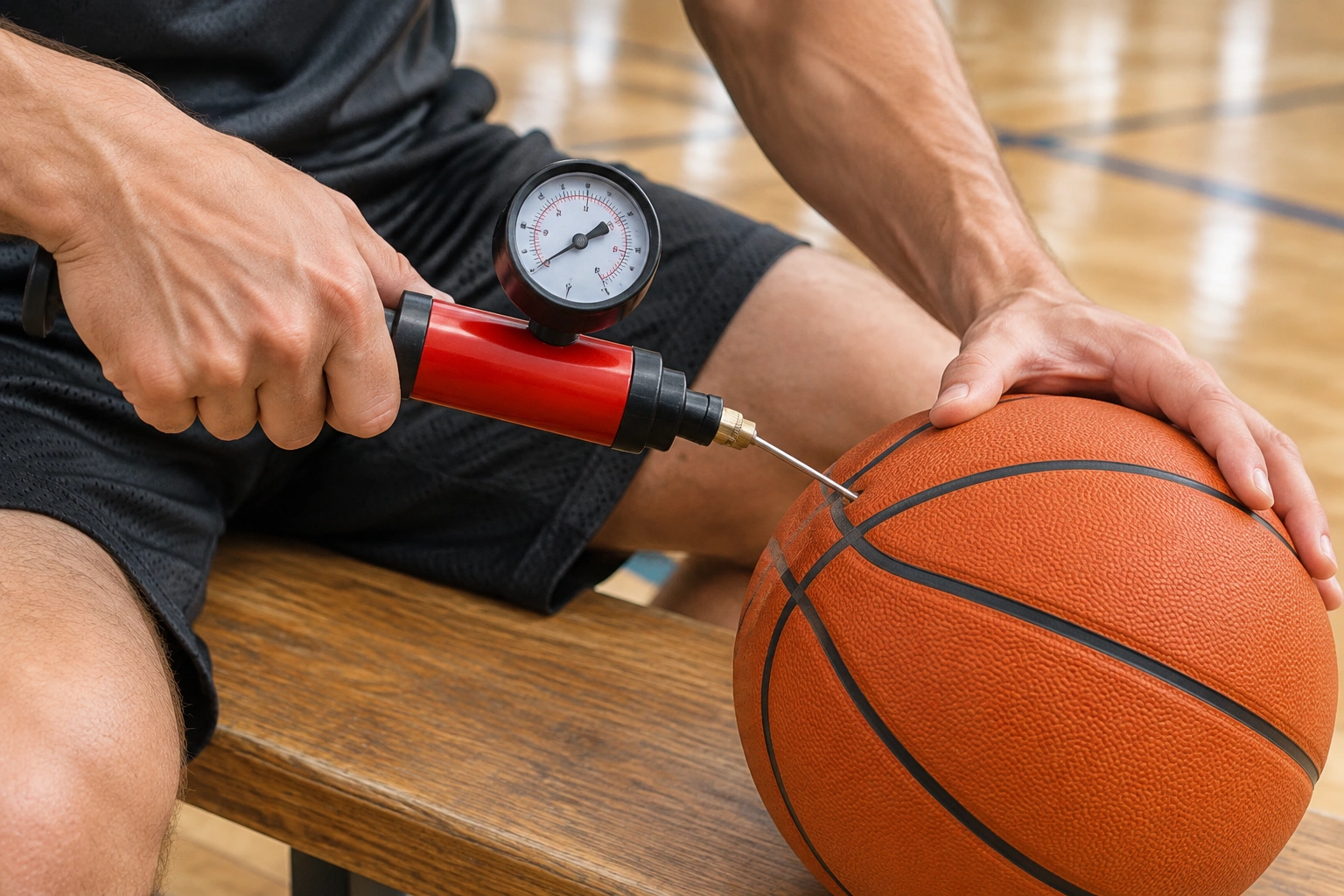
- A ball pump (hand pump, dual-action pump or electric pump)
- An inflation needle that fits the pump
- A pressure gauge (many pumps have one built in)
- A drop of water or glycerin to wet the needle
How to Inflate a Basketball: Step by Step
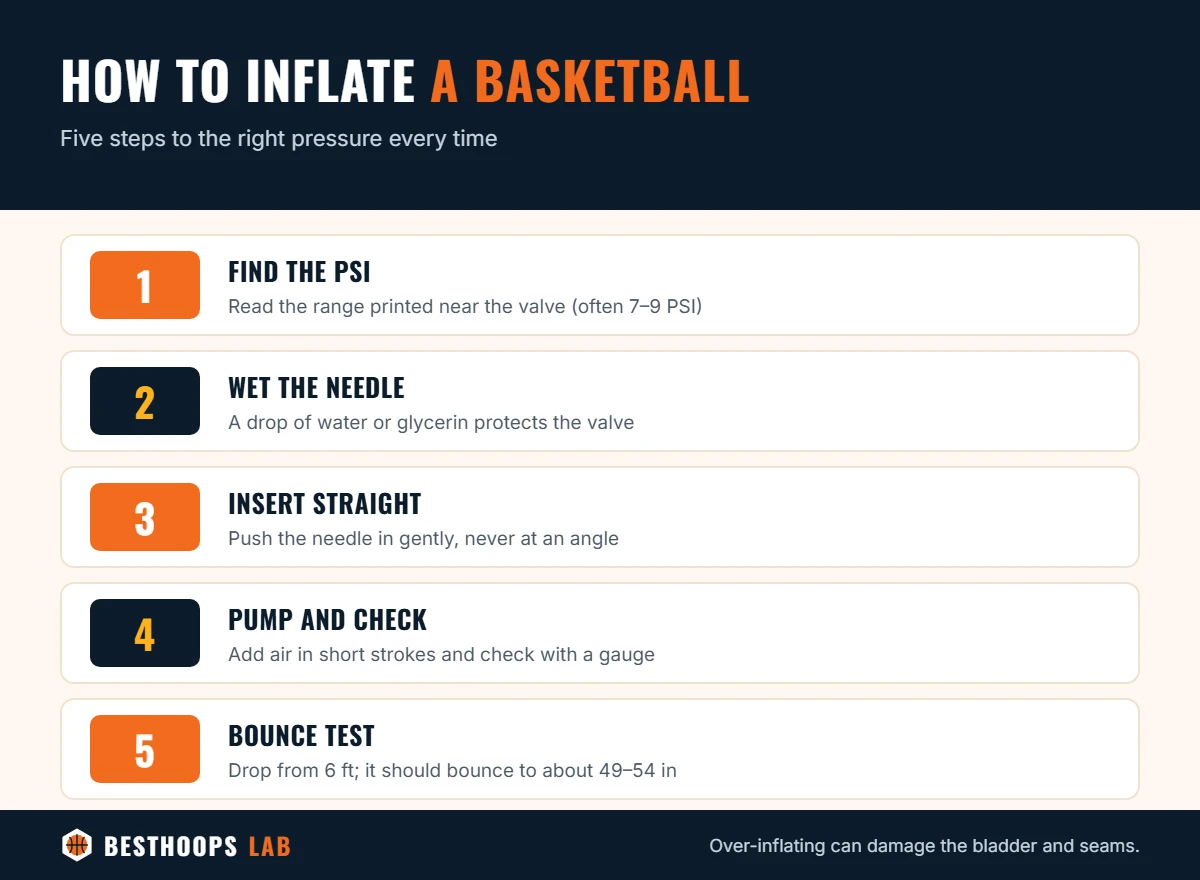
- Find the recommended PSI. Look near the valve or the logo for a range such as “7–9 PSI” or “0.5–0.6 bar.”
- Wet the needle. A drop of water or glycerin helps it slide in and protects the valve. Avoid oils and petroleum products.
- Insert the needle straight. Hold the ball steady and push the needle in gently. Never force it in at an angle, which can tear the valve.
- Pump in short strokes. Add a little air at a time and stop often to check.
- Check the pressure. Use the gauge, then remove the needle with a straight pull.
- Do the bounce test. A quick drop confirms the ball feels right on your court.
How to Do the Bounce Test
Basketball rules use a simple bounce test when no gauge is around. Hold the ball so its bottom is 6 feet above a hard floor and let it drop without pushing. A properly inflated ball bounces back so its top reaches roughly 49 to 54 inches. Lower than that means it needs air. Higher means let some out.
Signs Your Ball Has the Wrong Pressure
| Under-inflated | Over-inflated |
|---|---|
| Low, dead bounce | High, hard-to-control bounce |
| Feels soft when you squeeze it | Feels rock hard |
| Hard to dribble fast | Shots bounce out more often |
| Uneven wear on the cover | Extra stress on seams and bladder |
How Often Should You Add Air?
All balls slowly lose air. Check the pressure every week or two if you play often. Temperature matters too: a ball pumped up in a warm house will feel softer outside on a cold day, and the opposite in summer heat. Leaving a ball in a hot car can raise the pressure enough to stress the seams.
Frequently Asked Questions
What PSI should a basketball be?
Usually 7 to 9 PSI, with the NBA using 7.5 to 8.5 PSI. Always go by the range printed on your ball.
Can I inflate a basketball without a needle?
Not safely. Pushing in a pen, straw or other object can damage the valve and cause a permanent leak. Inflation needles are cheap and worth keeping in your bag.
Why does my basketball keep losing air?
Some loss is normal. If it goes flat in a day or two, the valve may be damaged or the bladder may have a small leak. Test by putting soapy water on the valve and watching for bubbles.
The Bottom Line
Check the PSI printed on your ball, wet the needle, pump in short strokes, and confirm with a gauge or the bounce test. A properly inflated ball plays better and lasts longer. If you are breaking in a new leather ball, our leather ball break-in guide has more care tips.