How Much Space Do You Need for a Basketball Hoop?
Besthoopslab is reader-supported. As an Amazon Associate, we earn from qualifying purchases.
Quick answer: For basic shooting you need a flat area of about 20 × 20 feet in front of the hoop. That fits a free-throw line (15 feet from the backboard) with room to rebound. A small half court for 2-on-2 needs about 30 × 30 feet, and a full high school half court is 42 × 50 feet. Add 2–3 feet of open space around the edges and make sure nothing hangs overhead.
Most families don’t need a regulation court. You need enough room to shoot, chase rebounds, and play a little one-on-one without running into a car, a fence, or a flower bed. Use the sizes below to see what fits your driveway or yard.
Space Needed by Play Area
| Play area | Minimum size (W × D) | What fits |
|---|---|---|
| Shooting spot | 15 × 15 ft | Close-range shooting and rebounding |
| Free-throw area | 20 × 20 ft | Free-throw line, lane, short jumpers |
| Small half court | 30 × 30 ft | 2-on-2, most mid-range shots |
| Medium half court | 35 × 40 ft | High school 3-point arc (19 ft 9 in) almost fits |
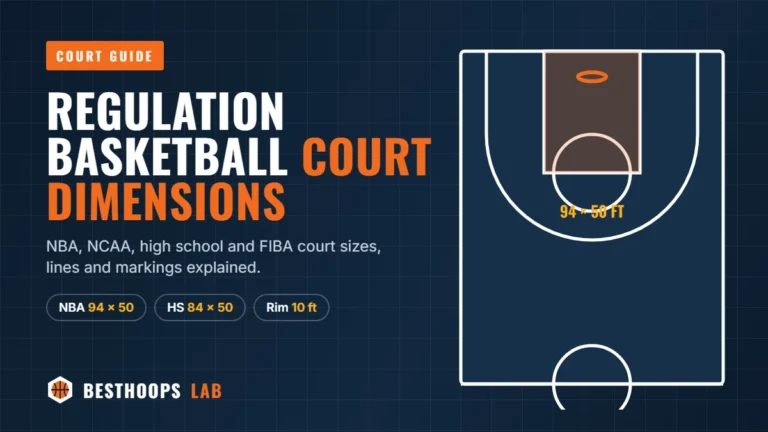
| High school half court | 42 × 50 ft | Full regulation high school half court |
| NBA half court | 47 × 50 ft | Full NBA half court with 23 ft 9 in arc |
Depth is measured from the baseline (under the hoop) out toward the street or yard. Width runs side to side. For full court sizes and line markings, see our basketball court dimensions guide.
Key Distances to Plan Around
- Free-throw line: 15 ft from the face of the backboard at every level.
- Lane (key) width: 12 ft for high school and college, 16 ft for the NBA.
- 3-point line: 19 ft 9 in (high school), 22 ft 1¾ in (college), 23 ft 9 in at the top of the NBA arc, all measured from the center of the basket.
- Backboard overhang: on a regulation court the backboard sits 4 ft inside the baseline. Home hoops usually have 2–5 ft of overhang.
Don’t Forget the Hoop’s Own Footprint
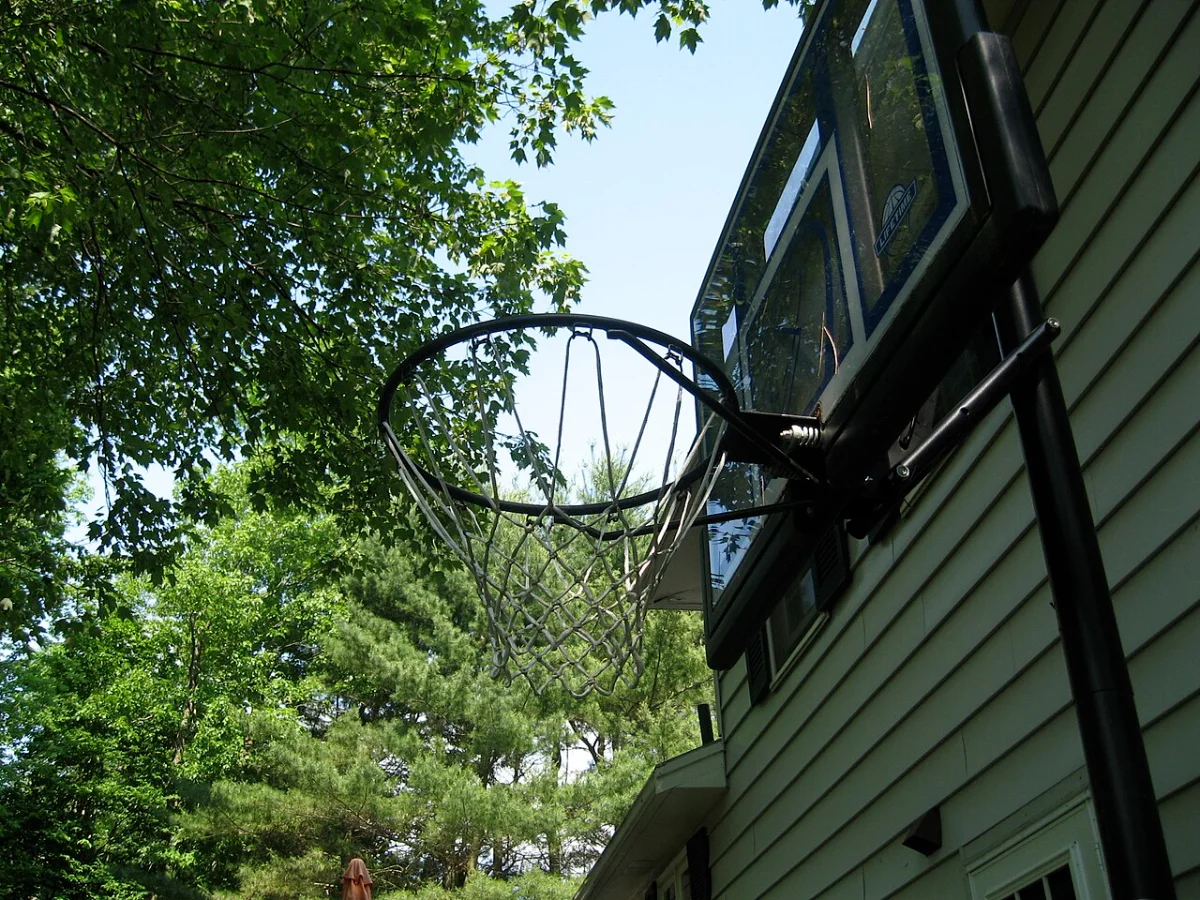
The hoop itself takes up space behind the playing area. A portable hoop’s base usually needs a spot about 3–4 ft long behind the backboard, and the base sits right under the edge of the court. An in-ground pole takes less room, but the pole should sit outside the playing area and be padded. Compare both styles in portable vs in-ground basketball hoops.
Clearance and Safety Checklist
- Overhead: keep the area above the hoop open to about 15–20 ft. No power lines, wires, or branches.
- Run-off room: leave 2–3 ft of open space beyond the edges so players don’t crash into walls, fences or cars.
- Street: never let the play area spill into the road. Point the hoop so missed shots bounce toward the house or yard.
- Windows: keep the backboard away from glass doors and low windows.
- Surface: use a flat, smooth surface. Concrete or asphalt is best. A slope of more than about 2% changes how the ball bounces.
Driveway vs Backyard
A typical two-car driveway is 18–24 ft wide and often 20–40 ft deep, so it already fits a free-throw area or small half court. A backyard gives you more room for a bigger slab but usually means pouring concrete. If you are thinking about building one, our backyard basketball court cost guide breaks down prices by size.
Frequently Asked Questions
What is the minimum space for a basketball hoop?
About 15 × 15 ft for simple shooting. To include a free-throw line and room to rebound, plan on 20 × 20 ft.
How big is a half basketball court?
A high school half court is 42 × 50 ft and an NBA half court is 47 × 50 ft. Most backyard half courts are smaller, around 30 × 30 to 35 × 40 ft.
How far should a basketball hoop be from the street?
Keep the whole play area off the street and leave a few feet of buffer. If the driveway is short, angle the hoop so the ball rolls toward the house, not the road.
How much overhead clearance do I need?
Keep at least 15–20 ft clear above the hoop so high-arc shots and rebounds don’t hit branches, gutters or wires.
Can I put a hoop on a sloped driveway?
Yes, but a slope changes the rim height across the court and makes the ball roll away. Measure rim height from the spot where you shoot most, and fill portable bases fully on a slope.
Photo Credits
Featured image: Dejan Krsmanovic via Wikimedia Commons, CC BY 2.0 (resized). All other photos are credited in their captions.