
Basketball Hoop Height by Age: The Complete Parent’s Guide (With Chart)
Besthoopslab is reader-supported. As an Amazon Associate, we earn from qualifying purchases.
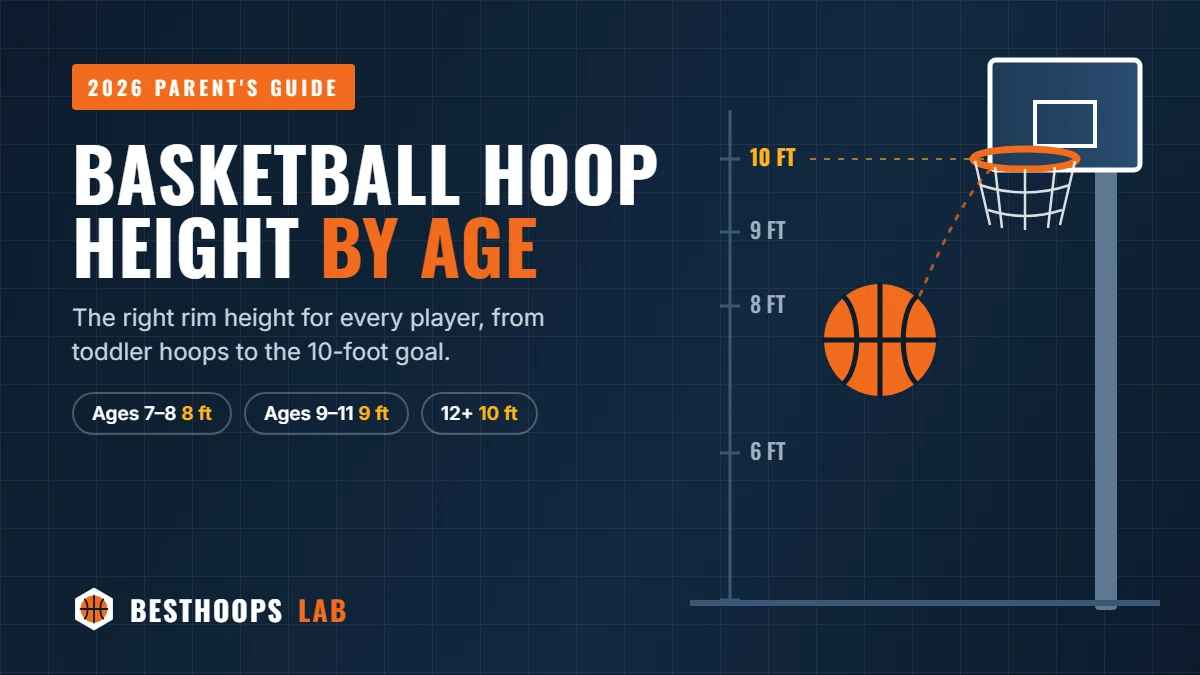
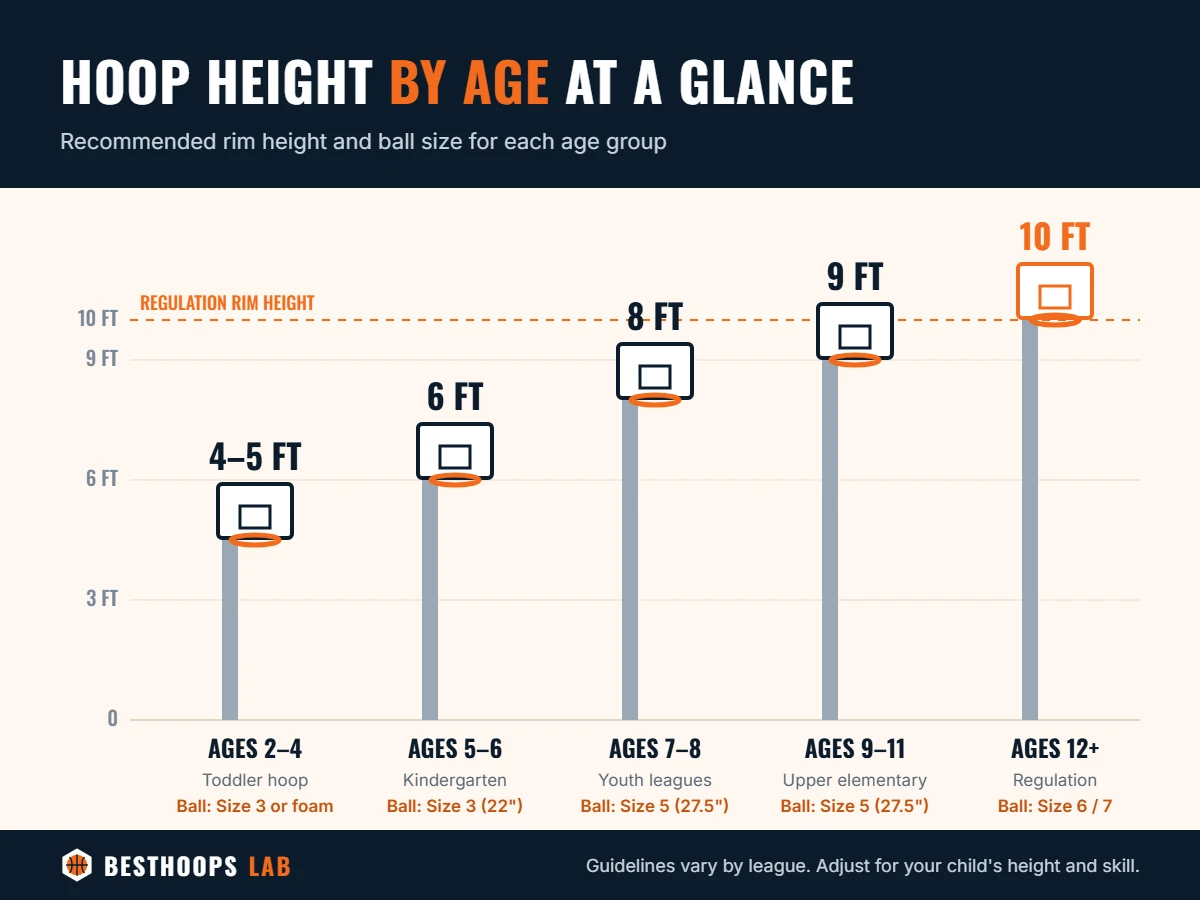
Quick answer: Kids ages 2–4 should shoot on a 4–5 ft hoop, ages 5–6 on a 6 ft hoop, ages 7–8 on an 8 ft hoop, ages 9–11 on a 9 ft hoop, and players 12 and older on the regulation 10 ft hoop. These heights follow the youth guidelines from USA Basketball and the NBA, and they help young players build a real shooting motion instead of heaving the ball.
If you have ever watched a 7-year-old fling a ball at a 10-foot rim, you know the problem. The rim is too high, the ball is too heavy, and the “shot” turns into a two-handed throw from the hip. That habit is hard to unlearn later. Setting the hoop at the right height is the easiest fix a parent or coach can make, and it costs nothing if you already own an adjustable hoop.
Basketball Hoop Height by Age: The Chart
| Age | Recommended rim height | Ball size |
|---|---|---|
| 2–4 (toddler) | 4–5 ft | Size 3 or a soft foam ball |
| 5–6 | 6 ft | Size 3 (22″) |
| 7–8 | 8 ft | Size 5 (27.5″) |
| 9–11 | 9 ft | Size 5 (27.5″) |
| 12 and up | 10 ft (regulation) | Size 6 (28.5″) or Size 7 (29.5″) |
Treat the chart as a starting point, not a rule. A tall 8-year-old who already shoots with good form may be ready for 9 feet, while a smaller 10-year-old may still do better at 8 feet. Your child’s form matters more than their birthday.
Why the Right Hoop Height Matters
Shooting is a skill built on repetition. When the rim is at the right height, kids can use a proper one-hand shooting motion: elbow under the ball, legs bending, wrist snapping through. When the rim is too high, they compensate with their whole body, and every rep teaches the wrong movement.
- Better form: a lower rim lets kids shoot with one hand and a natural arc.
- More makes, more fun: kids who see the ball go in keep practicing. Kids who miss 19 of 20 shots usually quit.
- Fewer bad habits: no slinging from the hip or pushing the ball from the chest.
- Safer play: younger kids can reach the ball and rebound without straining.

Hoop Height for Each Age Group
Ages 2–4: 4 to 5 Feet
At this age the goal is play, not technique. A freestanding toddler hoop or an indoor mini hoop set around 4–5 feet lets kids dunk, drop the ball in, and get excited about the game. Use a small, light ball or a foam ball they can hold with two hands.
Ages 5–6: 6 Feet
Kindergarteners can start learning a basic shot. A 6-foot rim is low enough that they can reach it with a two-hand set shot while they build strength. Many adjustable youth hoops start right around this height.
Ages 7–8: 8 Feet
This is when many kids join their first league. USA Basketball and the NBA recommend an 8-foot rim and a smaller ball for this group. It is the most important age to get the height right, because this is when a real shooting motion takes shape.
Ages 9–11: 9 Feet
Upper elementary players are stronger and can handle a 9-foot rim. Some leagues already play at 10 feet for 11-year-olds, so a good plan is to practice at 9 feet and move up for a few sessions a week as their form holds.
Ages 12 and Up: 10 Feet
From middle school on, players use the regulation 10-foot rim, the same height as high school, college, the NBA and FIBA. Girls typically use a size 6 ball from this age, and boys move to a size 7 by around 14 or 15.
How to Measure Your Hoop Height
- Use a tape measure and start at the playing surface, not the base of the pole.
- Measure straight up to the top edge of the rim, not the backboard.
- Check on a flat spot. A sloped driveway can change the real height by several inches.
- If your hoop has a height scale on the pole, check it once with a tape measure. Factory markings are not always exact.
Choosing a Hoop That Grows With Your Child
If you are buying a hoop for a young player, an adjustable model saves money in the long run. Look for these features:
- Height range: a range of about 7.5 to 10 feet covers ages 7 through adult. Toddler hoops usually stop around 5–6 feet.
- Adjustment type: crank and lift-assist systems are easier and more precise than telescoping poles with pins.
- Stability: portable hoops need a heavy base. Sand is heavier than water and does not freeze.
- Backboard size: 44 to 54 inches is plenty for driveway play; larger boards add weight and cost.
Frequently Asked Questions
What height should a hoop be for a 10-year-old?
Nine feet is the usual recommendation for ages 9–11. If your league plays at 10 feet, practice at both heights so the switch feels natural.
When should a child start shooting on a 10-foot hoop?
Most kids are ready around age 12. A simple test: if they can shoot from the free-throw line with one hand and good form, they are ready for 10 feet.
Is it bad for kids to shoot on a 10-foot rim?
It is not harmful, but it often leads to poor shooting habits because young kids have to throw the ball with their whole body. A lower rim builds better mechanics.
How high is an NBA hoop?
Exactly 10 feet from the floor to the top of the rim. High school, college, WNBA and international (FIBA) games use the same height.
The Bottom Line
Match the rim to the player, not the other way around. Start low, watch your child’s form, and raise the hoop when their shot stays smooth. A few inches can be the difference between a kid who quits and a kid who keeps shooting.